C Programming From Basics to Mastery
Switch Statement in C
Using floating-point numbers in switch statements in C is not recommended (and in many cases not even possible) due to several reasons:
1. Precision Issues
Floating-point numbers are stored in binary with finite precision, which can lead to subtle inaccuracies. This means that even if two floating-point numbers look equal in source code, they might not match exactly in memory due to rounding errors.
For example:
float a = 0.1;
float b = 0.1 * 3 / 3;
if (a == b) {
  printf("a == b\n"); // this will work
}
In a switch statement, the case labels must have exact matches, and such precision issues make it unreliable to use floating-point numbers.
float a = 0.1;
float b = 0.1 * 3 / 3;
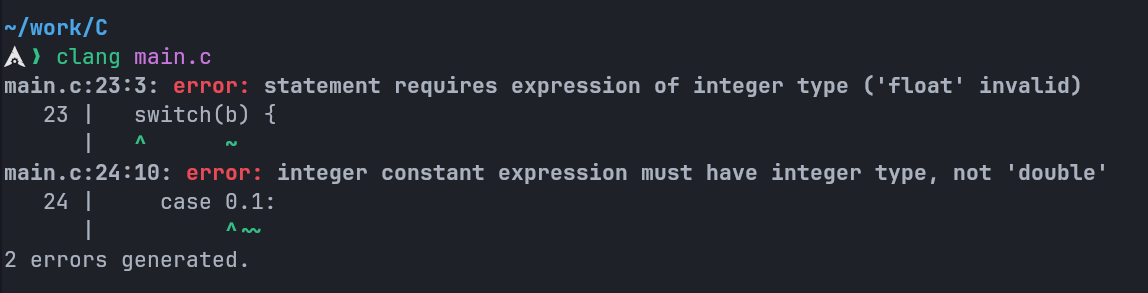
switch(b) { // error: Statement requires expression of integer type ('float' invalid)
  case 0.1: // error: Integer constant expression must have integer type, not 'double'
    printf("\n");
    break;
}
Attempting to write a switch statement with a float would result in the following errors:
2. Standard Restriction
The C standard (ISO C99 and later) specifies that the expression in a switch statement must evaluate to an integer or an enumerated type. Floating-point numbers are explicitly disallowed. The syntax is defined this way to ensure predictable and efficient behavior.
printf Format Specifiers
This table is listing the common printf format specifiers for various data types in C language
| Data Type | Format Specifier | Description | Example Usage |
|---|---|---|---|
int | %d or %i | Signed decimal integer | printf("%d", 42); |
unsigned int | %u | Unsigned decimal integer | printf("%u", 42); |
float | %f | Decimal floating-point | printf("%f", 3.14); |
double | %lf | Double floating-point | printf("%lf", 3.14); |
char | %c | Single character | printf("%c", 'A'); |
char* (string) | %s | String of characters | printf("%s", "hello"); |
short | %hd | Short signed integer | printf("%hd", 42); |
unsigned short | %hu | Short unsigned integer | printf("%hu", 42); |
long | %ld or %li | Long signed integer | printf("%ld", 42L); |
unsigned long | %lu | Long unsigned integer | printf("%lu", 42UL); |
long long | %lld or %lli | Long long signed integer | printf("%lld", 42LL); |
unsigned long long | %llu | Long long unsigned integer | printf("%llu", 42ULL); |
int (octal) | %o | Unsigned octal integer | printf("%o", 42); |
int (hexadecimal) | %x or %X | Unsigned hexadecimal integer (lowercase/uppercase) | printf("%x", 42); |
float/double (scientific) | %e or %E | Exponential notation (lowercase/uppercase) | printf("%e", 3.14); |
float/double (auto) | %g or %G | Shortest representation of %f or %e/%E | printf("%g", 3.14); |
void* (pointer) | %p | Pointer address (hexadecimal) | printf("%p", &var); |
Literal % | %% | Prints a percent sign | printf("%%"); |
Notes:
- Precision and Width: You can modify these specifiers with width and precision, e.g.,
%5.2ffor a float with 5 total characters and 2 after the decimal. - Platform Dependence: Some specifiers (like
%lffordouble) may behave differently depending on the compiler or standard (e.g., C89 vs. C99). - Size Modifiers: Use
h(short),l(long), orll(long long) to adjust for specific integer sizes.