Ahmad Ali Ahmad Othman - Section 1 - Sheet 1
1. Which of the following are analog quantities, and which are digital?
- Number of atoms in a sample of material -> Digital
- Altitude of an aircraft -> Analog
- Pressure in a bicycle tire -> Analog
- Current through a speaker -> Analog
- Timer setting on a microwave oven -> Digital
2. Which of the following are analog quantities, and which are digital?
- Width of a piece of lumber -> Analog
- The amount of time before the oven buzzer goes off -> Analog
- The time of day displayed on a quartz watch -> Display
- Altitude above sea level measured on a staircase -> Digital
- Altitude above sea level measured on a ramp -> Analog
3. Convert the following binary numbers to their equivalent decimal values:
A.
B.
C.
4. Convert the following binary numbers to decimal.
A.
(b)
C.
5. Using three bits, show the binary counting sequence from
| Decimal | Binary |
|---|---|
| 0 | 000 |
| 1 | 001 |
| 2 | 010 |
| 3 | 011 |
| 4 | 100 |
| 5 | 101 |
| 6 | 110 |
| 7 | 111 |
6. Using six bits, show the binary counting sequence from
| Decimal | Binary | Decimal | Binary |
|---|---|---|---|
| 0 | 000000 | 32 | 100000 |
| 1 | 000001 | 33 | 100001 |
| 2 | 000010 | 34 | 100010 |
| 3 | 000011 | 35 | 100011 |
| 4 | 000100 | 36 | 100100 |
| 5 | 000101 | 37 | 100101 |
| 6 | 000110 | 38 | 100110 |
| 7 | 000111 | 39 | 100111 |
| 8 | 001000 | 40 | 101000 |
| 9 | 001001 | 41 | 101001 |
| 10 | 001010 | 42 | 101010 |
| 11 | 001011 | 43 | 101011 |
| 12 | 001100 | 44 | 101100 |
| 13 | 001101 | 45 | 101101 |
| 14 | 001110 | 46 | 101110 |
| 15 | 001111 | 47 | 101111 |
| 16 | 010000 | 48 | 110000 |
| 17 | 010001 | 49 | 110001 |
| 18 | 010010 | 50 | 110010 |
| 19 | 010011 | 51 | 110011 |
| 20 | 010100 | 52 | 110100 |
| 21 | 010101 | 53 | 110101 |
| 22 | 010110 | 54 | 110110 |
| 23 | 010111 | 55 | 110111 |
| 24 | 011000 | 56 | 111000 |
| 25 | 011001 | 57 | 111001 |
| 26 | 011010 | 58 | 111010 |
| 27 | 011011 | 59 | 111011 |
| 28 | 011100 | 60 | 111100 |
| 29 | 011101 | 61 | 111101 |
| 30 | 011110 | 62 | 111110 |
| 31 | 011111 | 63 | 111111 |
7. What is the maximum number that we can count up to using 10 bits?
General rule:
8. What is the maximum number that we can count up to using 14 bits?
9. How many bits are needed to count up to a maximum of 511?
General rule:
10. How many bits are needed to count up to a maximum of 63?
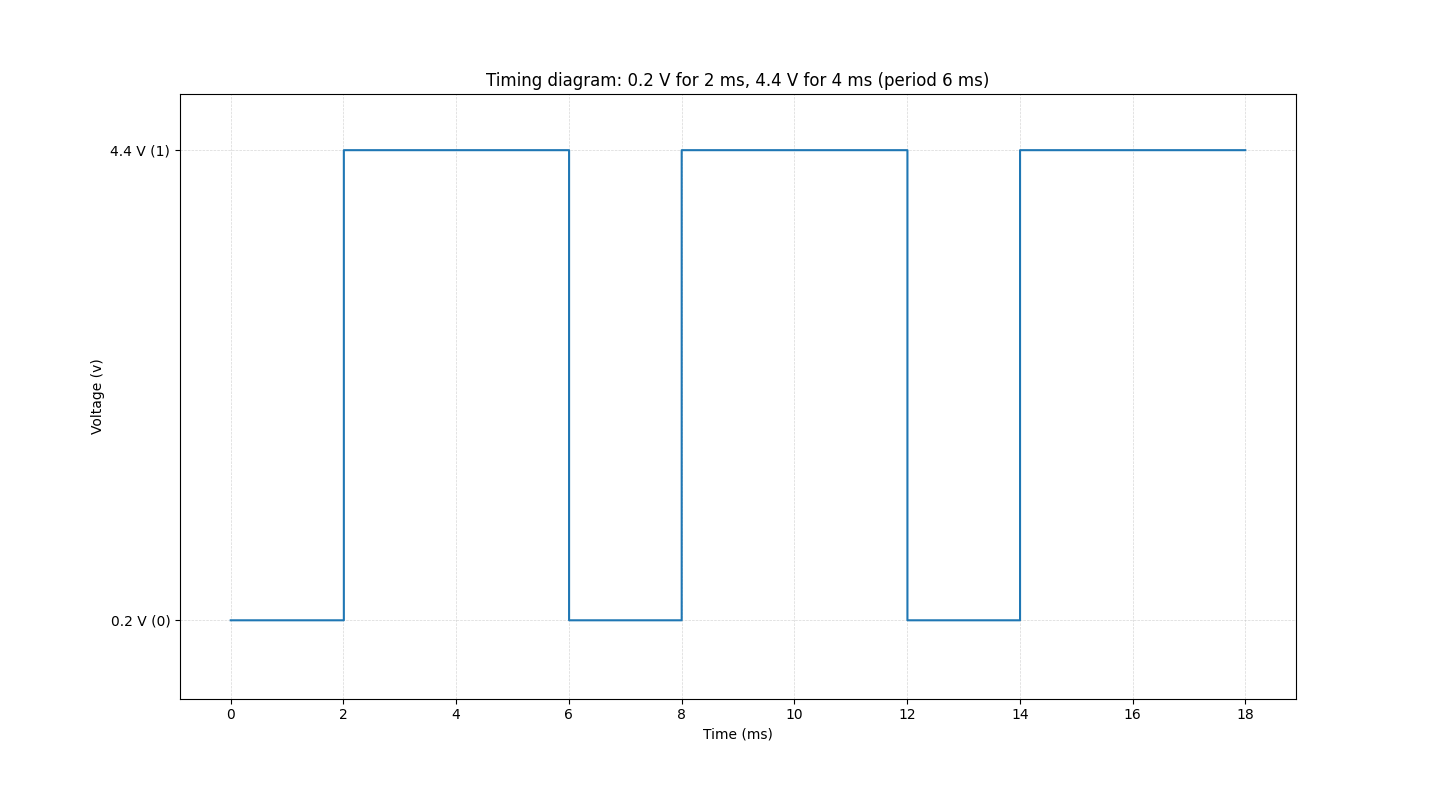
11. Draw the timing diagram for a digital signal that continuously alternates between 0.2 V (binary 0) for 2 ms and 4.4 V (binary 1) for 4 ms.
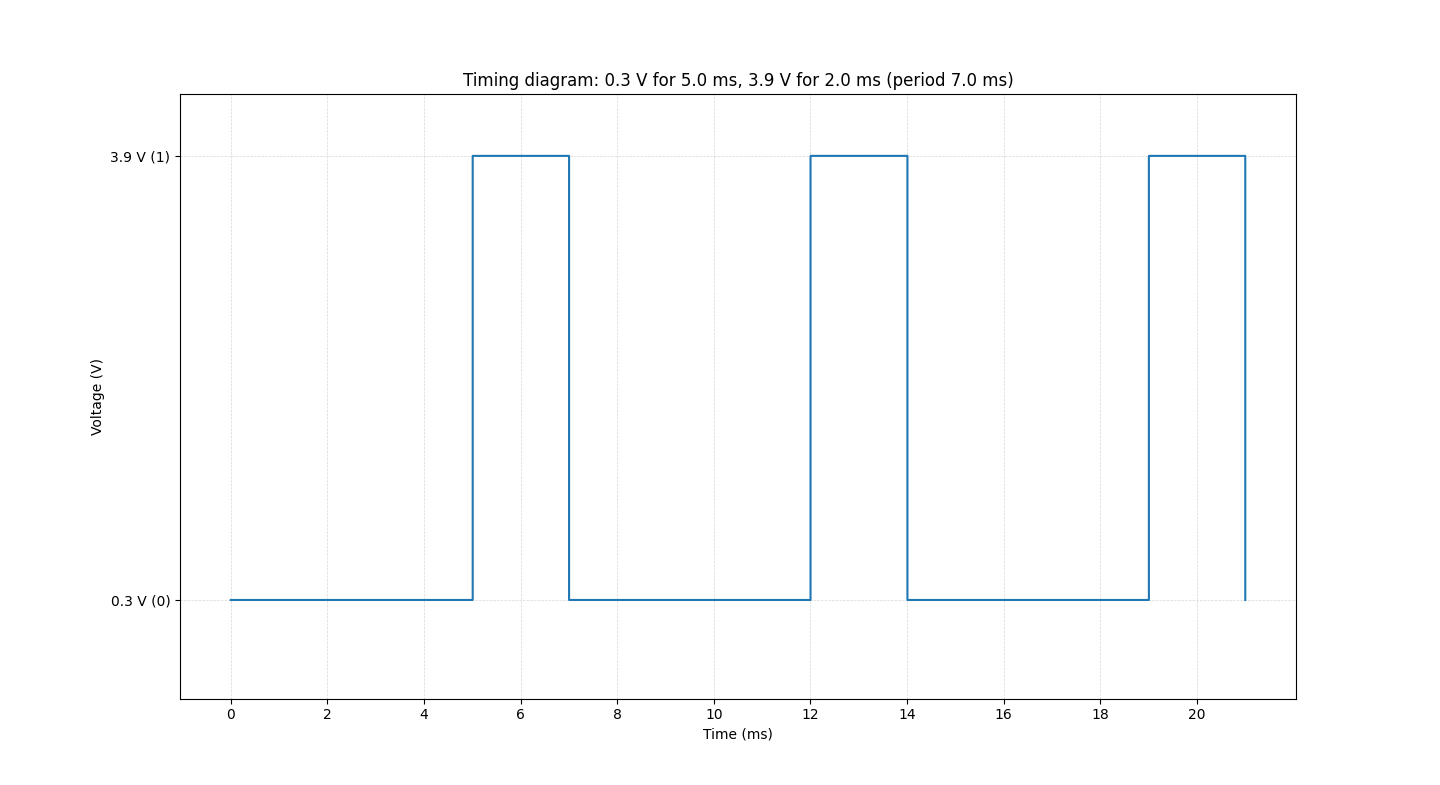
12. Draw the timing diagram for a signal that alternates between 0.3 V (binary 0) for 5 ms and 3.9 V (binary 1) for 2 ms.
13. Suppose that the decimal integer values from 0 to 15 are to be transmitted in binary.
- Numbers
to are represented by 4 bits ( ). - How many lines will be needed if parallel representation is used?
- Parallel representation sends all bits simultaneously (at the same time), each on its own separate line.
- That means it would use 4 Lines.
- How many will be needed if serial representation is used?
- Serial representation sends all bits sequentially one after the other, using a single line.
- It would use 1 Line.
14. How is a microprocessor different from a microcomputer?
Microprocessor
- A microprocessor is a single processor core that fetches, decodes, and executes instructions.
- It requires external memory (ROM/RAM), a memory decoder, an oscillator, and I/O ports to form a complete microcomputer.
- Handles arithmetic, logic, and control operations — cannot operate alone.
Microcomputer
- A complete computer system built around a microprocessor.
- Consists of the microprocessor + memory (RAM/ROM) + I/O ports + storage + power supply, etc.
- Fully functional — capable of running programs and performing tasks independently.
15. How is a microcontroller different from a microcomputer?
Microcontroller
- A microcontroller is a compact system-on-chip (SoC) with an integrated CPU, memory (RAM, ROM), and programmable I/O peripherals, designed for specific tasks.
- Used for dedicated control tasks in embedded systems (e.g., washing machines, sensors, robotics).
- Optimized for control and efficiency, not high-speed computing.
Microcomputer
- A complete general-purpose computing system that may use a microprocessor or microcontroller as its CPU.
- Used for general-purpose computing (e.g., personal computers, workstations).
- Optimized for flexibility and processing power.