Python Assignment Two
Scenario
You are applying for the position of a programmer in the Department of Computer Science and Systems at New Cairo Technological University.
The director has assigned the following tasks:
- Test your understanding of Python programming's fundamental ideas and subjects.
- Assess whether you can approach challenges with "software engineer thinking" to find the optimal solution.
Task 1
Write a Python program using elif to take a student's grade as input, with the grade ranging from 0 to 100. The program should determine the student's grade category based on the following criteria:
- Excellent: 85 or higher, up to 100.
- Very Good: 75 or above but less than 85.
- Good: 65 or above but less than 75.
- Acceptable: 60 or above but less than 65.
- Fail: Less than 60.
If the input value is outside the range of 0 to 100, the program should display an error message indicating that the supplied value is invalid.
Task 2
Mention the differences between while loop and for loop.
Task 3
Repeat the program from Task 1 to use loops, allowing the program to run repeatedly an unlimited number of times. The program should only stop when the user enters exit (case-insensitive).
NOTE
Solve this task without using functions.
Task 4
Create a program that entertains workers recording students' grades during their break. The program should ask the user to enter the number of lines needed to print the following shape:
*
**
***
Use loops to allow the program to run repeatedly an unlimited number of times. The program should only stop when the user enters exit in lowercase letters.
NOTE
Solve this task without using functions.
Task 5
Define lists and tuples and compare between them
Task 6
Define the dictionary in Python and mention its uses
Task 7
Re-write task 3 with using function
Task 8
Write program using a dictionary to store student name and degree data
Task 9
Write a program using a dictionary to store student names and their grades for four subjects. The program should accept the student's name and grades as input. Each subject has a maximum score of 100 marks. The program should calculate and output the total score and classify the student's general grade according to the following criteria:
- Excellent: 85% or higher, up to 100%.
- Very Good: 75% or above but less than 85%.
- Good: 65% or above but less than 75%.
- Acceptable: 60% or above but less than 65%.
- Fail: Less than 60%.
NOTE
Use all the notes mentioned above and apply everything you have learned, including control structures, functions, and lists.
Answers
Task 1
grade = int(input("Enter your grade (0~100): "))

if grade in range(101):
  if grade in range(85, 101):
    print("Excellent")
  elif grade in range(75, 85):
    print("Very Good")
  elif grade in range(65, 75):
    print("Good")
  elif grade in range(60, 65):
    print("Acceptable:")
  else:
    print("Fail")
else:
  print(f"Invalid grade: {grade}, you must enter values between 0 and 100.")
Task 2
| Aspect | While Loop | For Loop |
|---|---|---|
| Definition | Repeats a block of code as long as a specified condition evaluates to True. | Iterates over a sequence (e.g., list, range) or other iterable objects. |
| Use Case | Suitable when the number of iterations is unknown beforehand and depends on a condition. | Ideal for scenarios with a known sequence or range of items to iterate over. |
| Syntax | while condition: | for variable in sequence: |
| Control | Relies on a condition that may change within the loop to terminate. | Automatically terminates after iterating over all items in the sequence. |
| Flexibility | Can emulate a for loop by managing counters manually. | Specifically designed for sequential iteration, eliminating the need for manual counter management. |
| Risk of Infinite Loop | Higher risk if the condition is not properly handled. | Low risk since iteration is defined by the sequence length. |
Task 3
while True:
  grade = input("Enter your grade (0~100) or type 'exit' to quit: ")

  # The program stops only when the user writes the word `exit` in lowercase letters (case insensitive).
  if grade.lower() == "exit":
    print("Goodbye!")
    break
  else:
    grade = int(grade2)

  if grade in range(101):
    if grade in range(85, 101):
      result = "Excellent"
    elif grade in range(75, 85):
      result = "Very Good"
    elif grade in range(65, 75):
      result = "Good"
    elif grade in range(60, 65):
      result = "Acceptable:"
    else:
      result = "Fail"
    print(result, end="\n\n")
  else:
    print(f"Invalid grade: {grade}, you must enter values between 0 and 100.")
Task 4
while True:
  height = input("Enter the height: ")
  if height == "exit":
    print("Goodbye!")
    break
  elif height.isdigit():
    if 0 < int(height):
      for i in range(1, int(height)+1):
        print(i*"*")
    else:
      print("Invalid height, you must enter an integer bigger than 0.")
  else:
    print("Invalid height, you must either enter an integer or type 'exit' to quit.")
Task 5
Lists
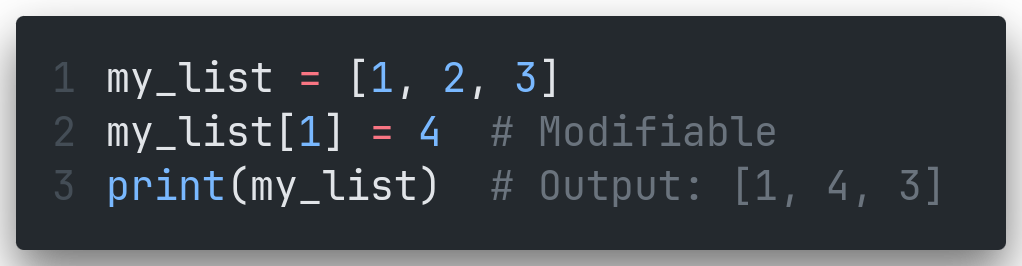
- Definition: Lists are mutable, ordered collections of items, where the items can be of any data type.
- Syntax:
[item1, item2, item3]
Tuples
- Definition: Tuples are immutable, ordered collections of items, where the items can be of any data type.
- Syntax:
(item1, item2, item3)
Comparison Between Lists and Tuples
| Aspect | List | Tuple |
|---|---|---|
| Mutability | Mutable (items can be added, removed, or changed). | Immutable (items cannot be modified once defined). |
| Syntax | [item1, item2] | (item1, item2) |
| Performance | Slower due to mutability overhead. | Faster due to immutability. |
| Memory Efficiency | Requires more memory. | More memory-efficient. |
| Use Case | Use when the data is expected to change frequently. | Use when the data is constant and should not change. |
| Methods | Has numerous built-in methods like append(), remove(), etc. | Has limited methods like count() and index(). |
Example
- List:
- Tuple:

Task 6
Definition of Dictionary in Python
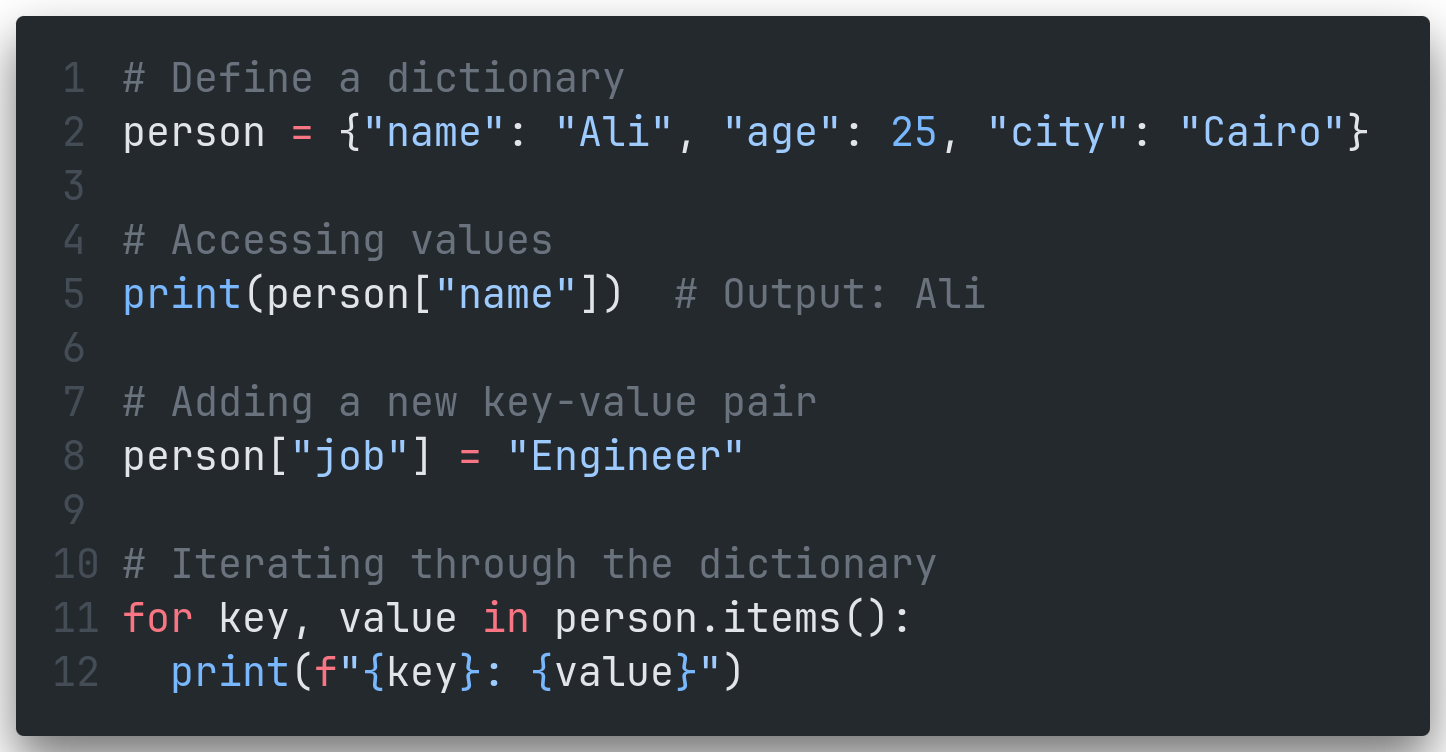
A dictionary is an unordered collection of key-value pairs in Python. Each key in a dictionary is unique and immutable, while the values can be of any data type and are mutable.
- Syntax:

Uses of Dictionaries
- Key-Based Data Retrieval: Accessing data quickly using keys instead of indices.
Example:
- Mapping Relationships: Representing relationships such as ID-to-name or product-to-price mappings.
Example:
- Dynamic Data Storage: Storing dynamic key-value data, such as configurations or user inputs.
Example:
- Efficient Updates: Easily updating, adding, or removing elements.
Example: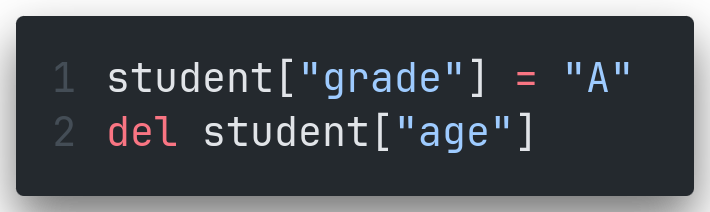
- Iterating Over Items: Iterating through keys, values, or both using loops.
Example: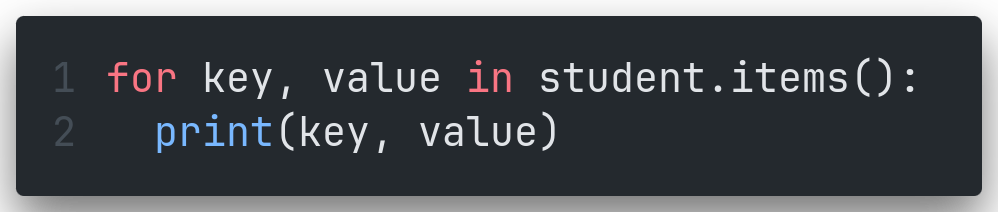
Example Dictionary in Python
Task 7
def task7():
  while True:
    grade = input("Enter your grade (0~100) or type 'exit' to quit: ")
    # The program stops only when the user writes the word `exit` in lowercase letters (case insensitive).
    if grade.lower() == "exit":
      print("Goodbye!")
      return
    elif grade.isdigit():
      grade = int(grade)
      if grade in range(101):
        if grade in range(85, 101):
          result = "Excellent"
        elif grade in range(75, 85):
          result = "Very Good"
        elif grade in range(65, 75):
          result = "Good"
        elif grade in range(60, 65):
          result = "Acceptable:"
        else:
          result = "Fail"
        print(result, end="\n\n")
      else:
        print(f"Invalid grade: {grade}, you must enter values between 0 and 100.")
    else:
      print(f"Invalid input, you must either enter an integer or type 'exit' to quit.")


task7()
Task 8
def task8():
  data = {}
  name = input("Enter your name: ")
  degree = int(input("Enter your degree: "))
  data = {
      "name": name,
      "degree": degree
  }
  print(data)


task8()
Task 9
def inFloatRange(value, start=0, end=1):
  return start <= value and value < end


def getGrade(percentage: float):
  if inFloatRange(percentage, 0, 101):
    if inFloatRange(percentage, 85, 101):
      return "Excellent"
    elif inFloatRange(percentage, 75, 85):
      return "Very Good"
    elif inFloatRange(percentage, 65, 75):
      return "Good"
    elif inFloatRange(percentage, 60, 65):
      return "Acceptable:"
    else:
      return "Fail"
  else:
    print(f"Invalid percentage: {percentage}, you must enter values between 0 and 100.")
    exit(-1)


def task9():
  data = {}
  marks = 0
  data["name"] = input("Enter your name: ")
  for i in range(1, 5):
    marks += int(input(f"Please enter you mark for subject{i}: "))

  if not marks in range(401):
    print("Invalid input, marks should be between 0 and 400.")
    return

  data["total_marks"] = marks

  percentage = (marks * 100) / 400

  data["grade"] = getGrade(percentage)

  print(data)


task9()