Cybersecurity Essentials Lecture Two
What is Security of Data Model?
The OSI security architecture provides a structured approach to implementing and managing security. Developed as an international standard, it helps vendors align their security features to meet defined services and mechanisms.
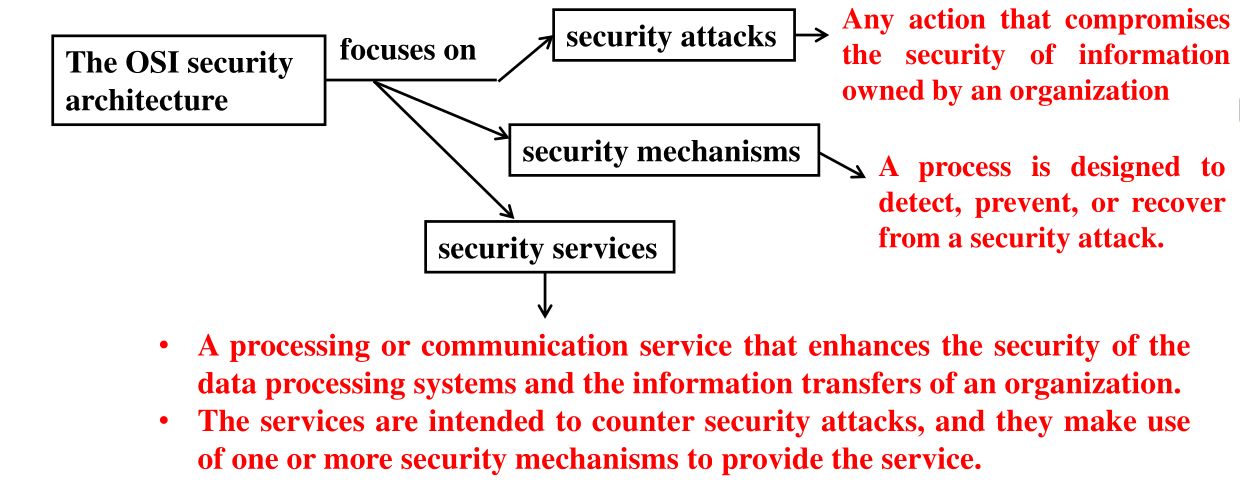
Threat, Vulnerability, Attack
- Threat: Any event or circumstance with the potential to negatively impact organizations or individuals through unauthorized access, disclosure, modification, destruction, or denial of service.
- Vulnerability: A system weakness that can be exploited to cause harm.
- Attack (Incident): Occurs when a threat exploits a vulnerability.
- Countermeasure (Control): Actions that reduce threats or vulnerabilities, aiming to prevent, deflect, or respond to attacks.
Security Attacks
- Passive Attacks: Attempt to gain information without affecting system resources.
- Active Attacks: Aim to alter system resources or disrupt operations.
Security Services
Security services support requirements such as:
- Confidentiality
- Integrity
- Availability
- Authenticity
- Access Control
- Non-repudiation
They are implemented via specific security mechanisms.
Security Mechanisms
- Cryptographic Algorithms:
- Reversible: Encryption algorithms for encryption and decryption.
- Irreversible: Hash functions and message authentication codes (e.g., digital signatures).
- Data Integrity: Ensures data remains unchanged.
- Digital Signature: Verifies source and integrity of data.
- Authentication Exchange: Confirms identity through information exchange.
- Traffic Padding: Obscures patterns in data transmission.
- Routing Control: Chooses secure transmission paths.
- Notarization: Uses a trusted third party to verify data exchange properties.
- Access Control: Enforces access permissions.
Cryptography
Cryptography is the mathematical science of securing data through transformation. It's vital for ensuring safe communication and data storage.
Cryptographic Algorithms
- Keyless Algorithms: Do not use keys; includes hash functions and pseudorandom number generators.
- Single-Key Algorithms: Use one secret key for encryption and decryption.
- Two-Key Algorithms: Use a pair of related keys — a public key and a private key.
Keyless Algorithms
Used for integrity and verification. Main types include:
- Cryptographic Hash Functions: Convert variable-length data into a fixed-size output (digest).
- Properties:
- Same input gives the same output.
- Fixed output length.
- Fast computation.
- Unpredictable and non-reversible.
- Collision-resistant.
- Common Algorithms:
- Secure Hash Algorithms (SHA-0, SHA-1, SHA-2, SHA-3)
- Message Digest (MD2, MD4, MD5, MD6)
- Properties:
- Pseudorandom Number Generators: Produce seemingly random, deterministic sequences.
SHA-1 (Secure Hash Algorithm 1)
SHA-1 produces a 160-bit (20-byte) message digest from input data, typically displayed as a 40-character hexadecimal number.
SHA-1 Logic Operations
a | b | !a | a&b | a|b | a^b |
|---|---|---|---|---|---|
| 0 | 0 | 1 | 0 | 0 | 0 |
| 0 | 1 | 1 | 0 | 1 | 1 |
| 1 | 0 | 0 | 0 | 1 | 1 |
| 1 | 1 | 0 | 1 | 1 | 0 |
- Right Shift (
>>): Shifts bits right, discards least significant bits. - Left Shift (
<<): Shifts bits left, fills with zeroes.
Example: Encrypting "hi" using SHA-1
- ASCII Conversion: Convert each character to ASCII (h -> 104, i -> 105).
- Binary Conversion: Convert ASCII to 8-bit binary (104 ->
01101000, 105 ->01101001). - Combine Binary: Concatenate binary bits (
0110100001101001, 16 bits). - Append 1: Add a single 1 bit (
01101000011010011, 17 bits). - Pad with Zeros: Add
0s to reach 448 bits. - Append Length: Add 64-bit binary representation of original length (16) to form a 512-bit chunk.
- Split into Words: Divide 512-bit chunk into 16 words (32 bits each).
- Extend Words: Expand 16 words to 80 words using XOR operations (e.g.,
). - Initialize Constants:
- h0 =
01100111010001010010001100000001(A = h0) - h1 =
11101111110011011010101110001001(B = h1) - h2 =
10011000101110101101110011111110(C = h2) - h3 =
00010000001100100101010001110110(D = h3) - h4 =
11000011110100101110000111110000(E = h4)
- h0 =
- Process 80 Words in 4 Functions (20 words each):
- Function 1 (W0–W19):
- Truncate Temp to 32 bits
- Update:
, , , ,
- Function 2 (W20–W39):
- Same Temp and update steps
- Function 3 (W40–W59):
- K = 01011010100000100111100110011001
- Same Temp and update steps
- Function 4 (W60–W79):
- Same Temp and update steps
- Function 1 (W0–W19):
- Final Hash:
- Compute:
, , , , - Truncate each to 32 bits
- Convert to hexadecimal
- Compute:
- Output: Concatenate h0, h1, h2, h3, h4 as the final SHA-1 hash.